What to know before treating Megawin rummy as skill
Discard reading is legal. The next stock card is not a plan.
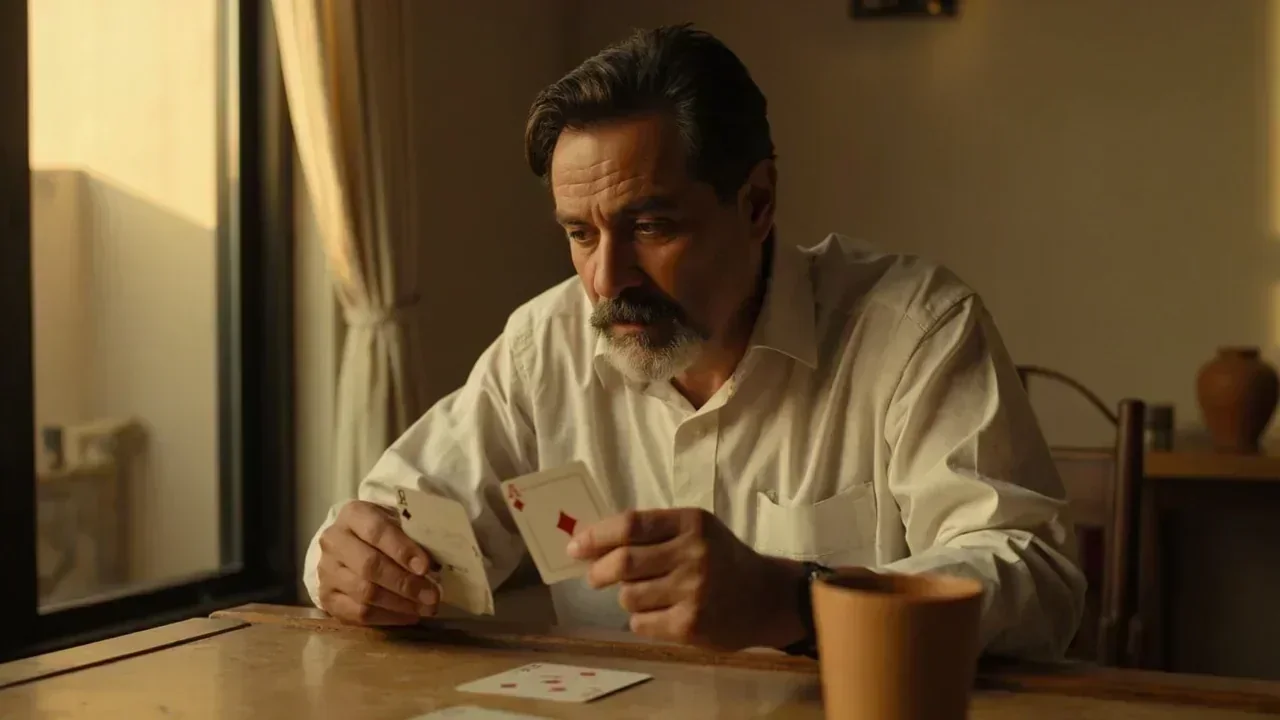 A pause is a choice. It is not a forecast.
Allowed choices versus things this desk will not promise
A legal skill choice is an action the rules already permit: which card to throw, whether to take an open discard, whether a first drop is cheaper than chasing a broken run, whether to break 10-J-Q to cut ten-point deadwood. Those choices change the shape of the hand you still hold.
A promise is a claim about results you cannot control: a win rate, a bankroll curve, a safe system, a recovery after a bad sitting. This desk lists the first group and refuses the second. If a sentence needs a dataset we do not have, it stays off the note.
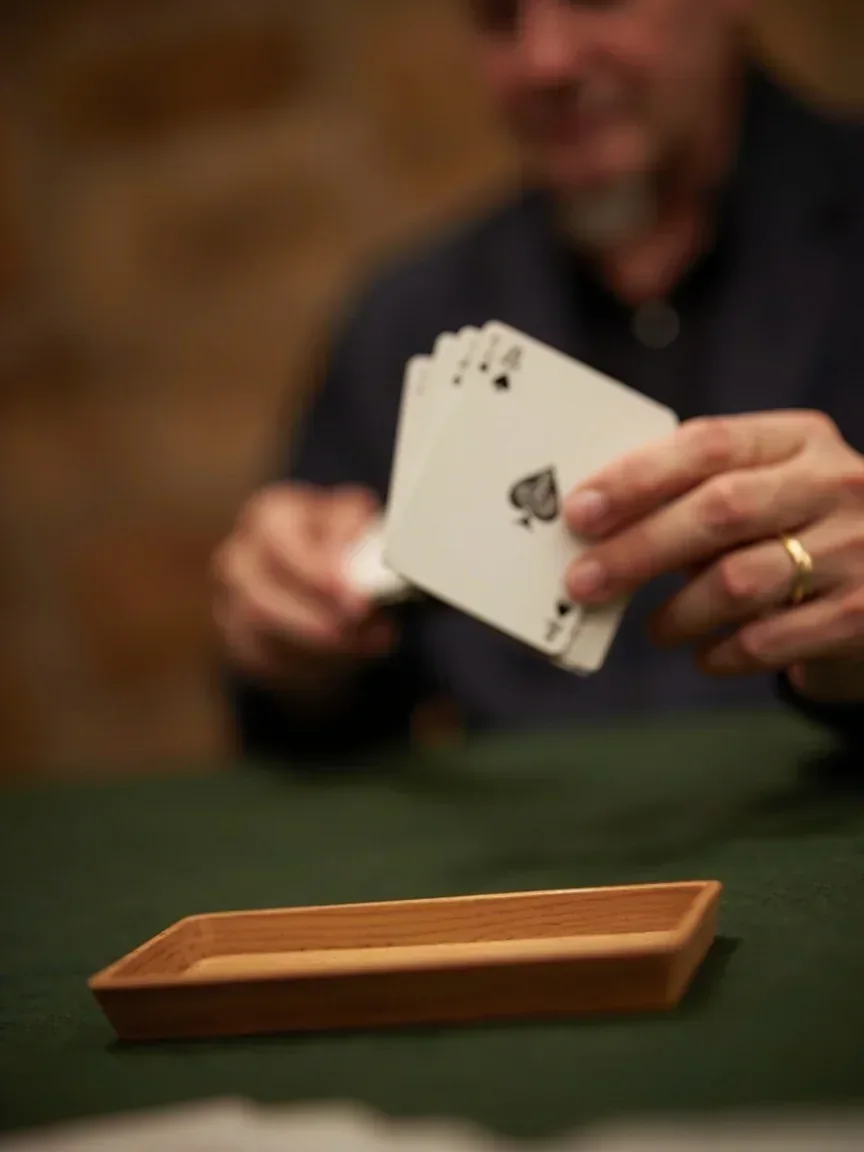 One card toward the tray. The rest stay private.
Keep or discard is a visible fork
The keep-or-discard portrait is the entire argument in a gesture. One card moves toward the tray. The rest stay against the body. The skill, such as it is, lives in that movement. The chance lives in whatever remains unseen.
Throwing a connector because it is high can cut deadwood and gift a neighbour a run. Holding it can leave you exposed if someone else shows. Both outcomes are possible. Naming both is the boundary. Selling only one is marketing.
 A draw from a closed pile. The face stays unknown.
The closed stock is a chance object
Once the card is in the stock, no amount of discard memory turns it into a scheduled event. You can know what has been thrown. You cannot know the order of what has not.
Players dress this up as 'I was due'. Due is not a table state. The photograph of a face-down draw exists so that sentence has a picture instead of a speech.
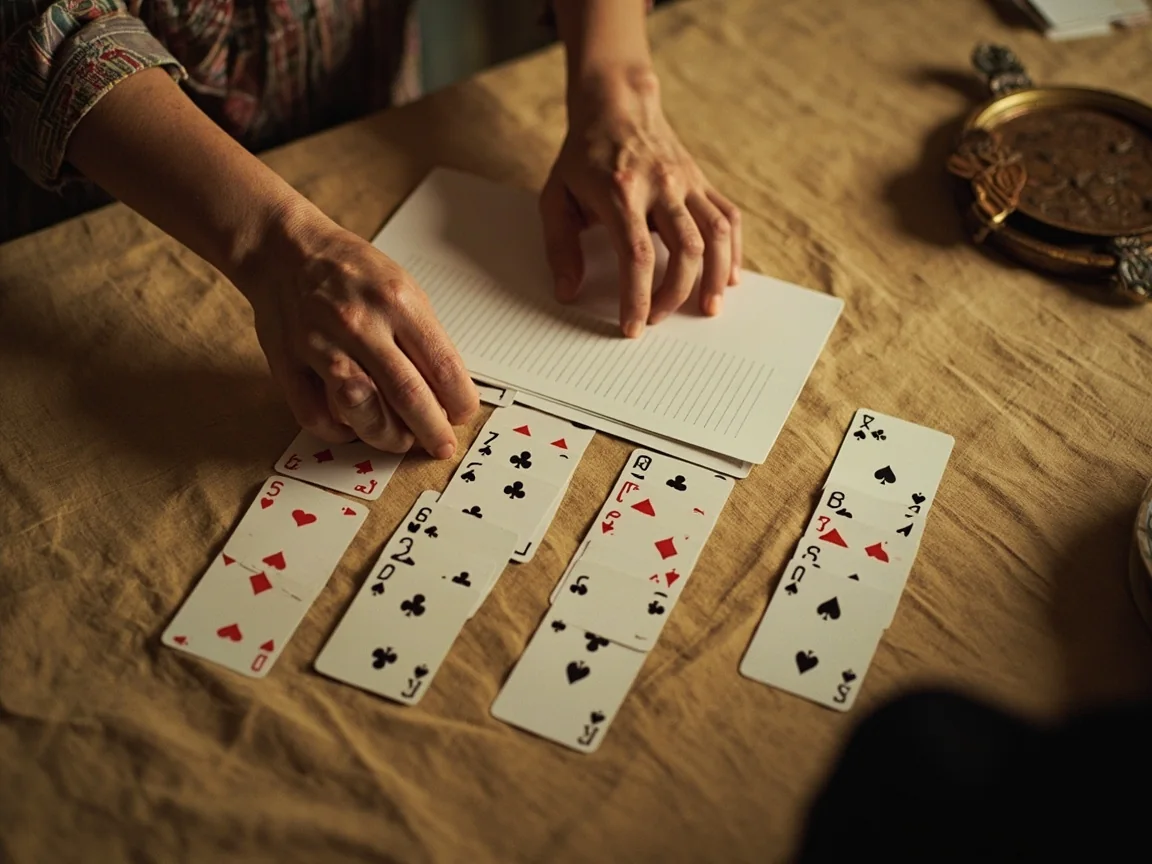 Leftovers split from a finished row. The slip stays blank.
Deadwood reduction is arithmetic, not prophecy
Unmatched cards are a bill waiting for someone else to show. Cutting a ten-point face card by breaking a pretty but unfinished run can be rational on Points. It can be wrong if that run was one natural card from a pure sequence.
The arithmetic is allowed. The claim that the arithmetic wins the sitting is not. Megawin leftover values stay unpublished, so this note talks in ranks and shapes, not in rupees.
Worked fork: keep 10-J-Q or break it
You hold 10-J-Q of clubs and two stray kings. No second sequence is close. A neighbour has picked two clubs from the open pile. Keeping the run protects a future pure sequence and feeds a player who may already have the 8-9 or the K of clubs.
Breaking the Q to cut a ten-point leftover reduces the bill if someone shows now. It also destroys the only natural run. The allowed thought is to name both costs. The forbidden thought is that a system tells you which cost is 'always' smaller.
First drop as a cheaper unfinished hand
If the dealt thirteen cannot grow a pure sequence without a specific unseen card, a first drop is often cheaper than a middle drop and cheaper than an invalid show. That comparison uses the usual club order of costs. It does not use a Megawin price list, because none is published here.
Staying out of stubbornness is not skill. Leaving because the shape is dead is a table choice. Neither action can be sold as a long-run edge without a dataset this desk does not have.
What other players throw is information, not a script
If the same player throws hearts and later picks a heart, you learned something about that hand. You did not learn the next stock card. You did not learn whether they hold a joker. Treat the information as a constraint on their possible sets, then stop.
Turning a single pickup into a story about their whole plan is how people invent certainty. The boundary list exists to cut that story back to the observed discard.
Not a promise: win rate, bankroll, safe systems
The table is the artifact of this route. It is not a rating of Megawin and not a tip sheet.
| Claim | Status on this desk | Why |
|---|---|---|
| Published win rate | Absent | No primary dataset |
| Bankroll growth | Refused | Result claim, not a rule |
| Safe system | Refused | Sells certainty |
| Recovery after a loss | Refused | Chasing, not a meld |
| Discard reading | Allowed | Uses visible cards |
| First drop when the run is dead | Allowed | A priced exit |
Bankroll growth
Safe system
Recovery after a loss
Discard reading
First drop when the run is dead
This note will not reteach declaration order
If you still need the meaning of a pure sequence, open the how-to sequence. Repeating deal-draw-discard-show here would clone that desk. Strategy starts after those words are already stable.
If you still need Points versus Pool, open the format ledger. This note assumes a format has been named and asks only what a player may legally choose inside it.
Chance does not become skill by adding adjectives
Words like tight, disciplined and mature do not move a closed stock card. They describe a mood. This desk prefers verbs: throw, keep, drop, wait. If a sentence cannot attach to one of those verbs and a named card shape, it is probably a pep talk.
Read the usability ledger next if your real question is whether you can even find a table, finish a check or reach a human. That is a different job.
A sitting can be left for reasons that are not strategic
Fatigue, a rising stake you did not plan, or a simple wish to stop are valid exits. They are not listed as skill. They are listed so this note cannot be read as an order to keep playing until the arithmetic looks pretty.
Open the control tools if you need a stop that is not dressed up as a clever drop.
Worked fork: take the open 8 or draw closed
An 8 of hearts sits on the open pile. You hold 6-7 of hearts and a loose 8 of spades. Taking the open 8 completes a natural run and advertises hearts. Drawing closed might be a useless low card and keeps the advertisement off the table.
The allowed analysis names the advertisement cost and the completion gain. The refused analysis says 'always take connectors'. Always is a system. Systems are in the not-a-promise column.
What would change this boundary list
A Megawin house sheet that publishes leftover values, first-drop prices and a sample of completed hands would let this note replace rank-talk with measured cost. Until that sheet exists, the list stays qualitative.
A claim that Megawin is a pure skill product would also change the note, but only if a regulator or the operator published that status with a method. Informal certainty from a comment thread would not.
A last worked fork: hold two kings or throw the high one
You hold two kings, a broken 4-5 of spades and a ten of diamonds. Throwing the ten cuts a likely ten-point leftover and may feed a diamond run. Holding it waits for a third king that may never arrive.
The allowed thought names both bills. The refused thought says kings always pay. Always is a system. Systems stay in the not-a-promise column.
When to stop reading a boundary list
If you can already name one allowed choice and one refused promise, the list has done its work. Further examples will not turn the stock pile into a plan.
Open Reviews if your real friction is navigation or support. Open control tools if your real friction is not being able to stand up.
Boundary questions
Can good discards raise a published win rate?
No published Megawin win rate exists on this desk. Discard quality changes exposure. It does not write the next card.
Is a first drop a skill move or a quit?
It is a legal cost choice when a pure sequence is not forming. It is not a character test.
Do systems that recover losses belong here?
No. Recovery systems are sales copy. They are listed as not a promise.