Megawin how to play: legal melds, drops, declaration
Deal, draw, discard, show. An invalid show is a full leftover bill.
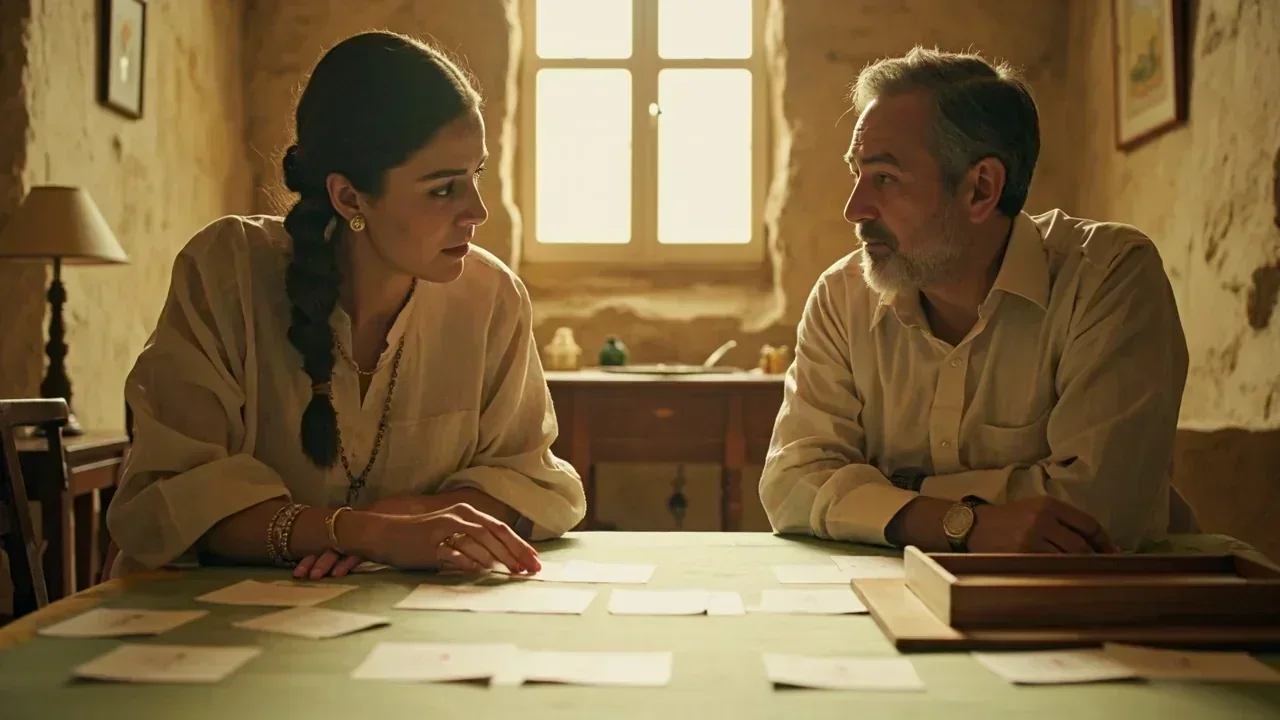 A teaching sitting. Indices face the sitters, not the lens.
The table sequence in order
Open with the action, not with a history of the game. You are dealt 13 cards. You keep them private. You then either drop or play. If you play, you draw one card and discard one card until someone shows or everyone still in the hand finishes under the house close.
That order is general 13-card convention. Megawin-specific timers, auto-drops and wild-card sheets are unpublished. If a later screen prints a different order, believe the screen, not this note.
| Step | Legal action | Common failure |
|---|---|---|
| Deal | Hold 13 cards. Do not expose indices. | Arranging the hand so a neighbour can read it. |
| Draw | Take the open discard or the closed stock. | Taking a discard that breaks your only pure-sequence plan. |
| Discard | Return exactly one card to the open pile. | Throwing the connector another player has been signalling. |
| Show | Declare with the required sequences. | Showing a set-heavy hand with no pure sequence. |
| Invalid show | Accept the leftover count. | Arguing the show after the cards are down. |
Draw
Show
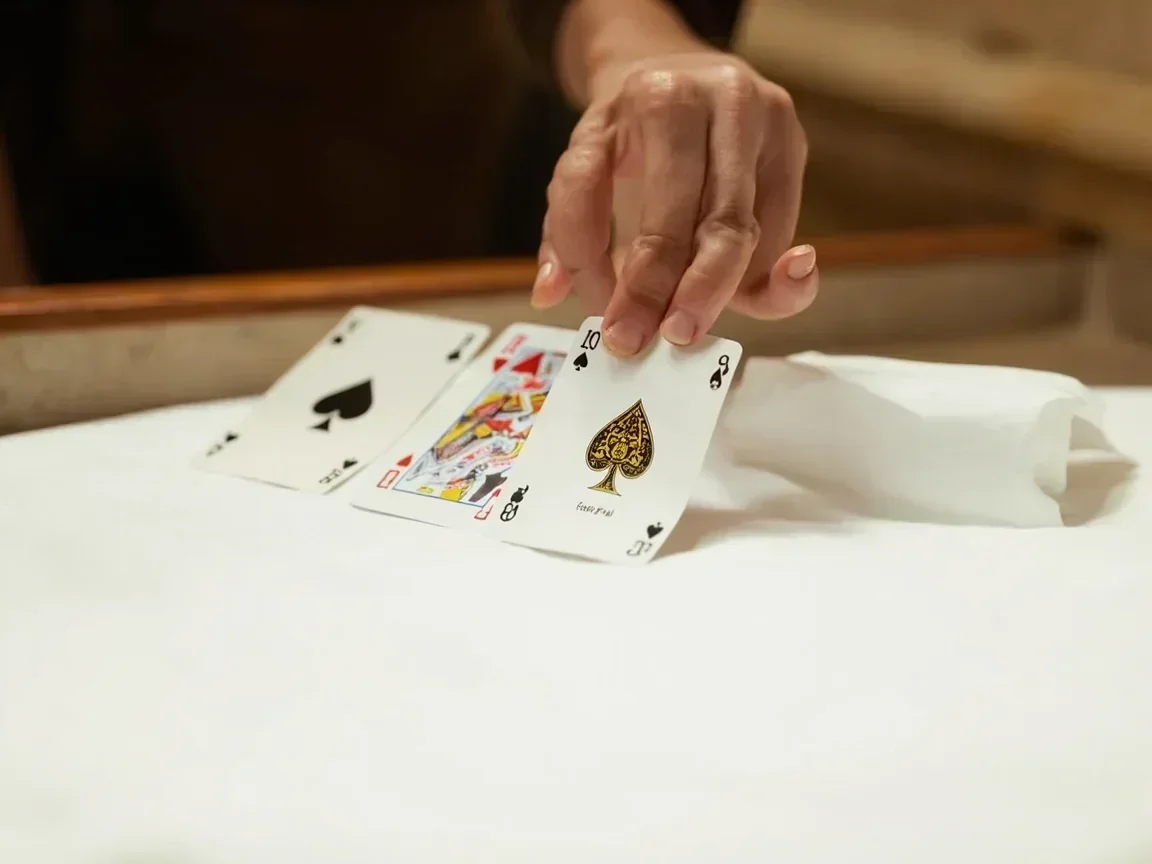 A sequence arriving. Pips only, indices covered.
A sequence is consecutive and same-suit
A legal sequence is a run of three or more cards in one suit. 5-6-7 of clubs is a sequence. 5-6-7 of mixed suits is not. 5-7-8 of clubs is not consecutive.
The first required sequence in common 13-card practice must be pure: no printed joker, no wild. If your only run uses a joker as a missing 6, you do not yet have a legal show.
The photograph shows a fourth card joining a run. That is completion, not decoration. If you cannot point to a pure run in your hand, you are not ready to declare.
Sets, jokers and the thing a joker cannot do
A set is three or four cards of the same rank in different suits. Three kings is a set. Two kings and a joker is a set in common practice. Four kings with a repeated suit is a house question we cannot answer without a sheet.
Evidence: general convention.
A printed joker may stand in a set or in a second sequence. It may not complete the one pure sequence the show requires. If you treat every joker as a universal fixer, you will produce invalid shows.
Megawin wild-card extras: unpublished.
Build the pure sequence first. Everything else is secondary. A beautiful set of aces does not rescue a missing run.
This is the most common beginner inversion.
A set is a rank group, not a run
The set photograph shows three cards being squared. Indices are folded under so this desk does not invent ranks. The lesson is grouping, not a printed example like 'three 9s' that the picture cannot prove.
If you cannot say whether your group is a set or a broken sequence, do not declare. Draw or drop instead.
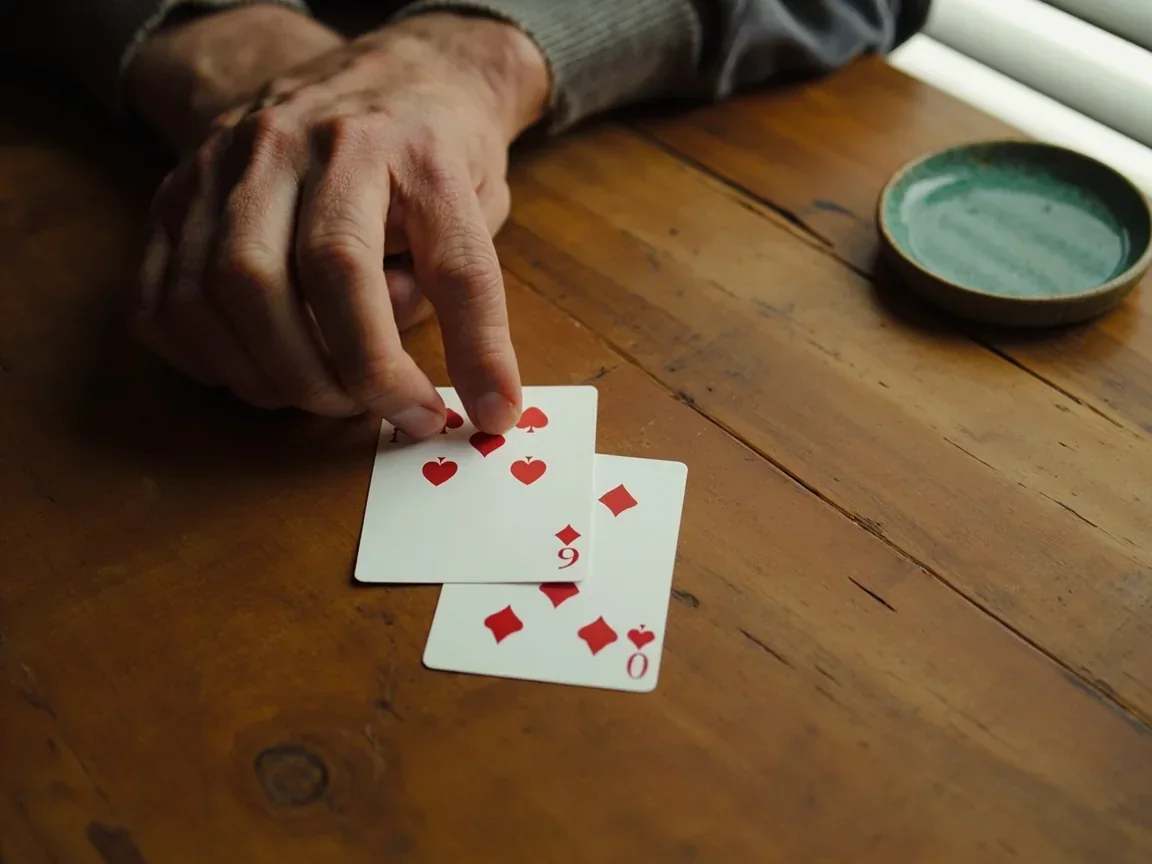 A set being squared. No readable indices.
First drop, middle drop, full count
A first drop is leaving before you have played a card from the dealt hand. A middle drop is leaving after the hand is live. A full count is what usually happens if you stay and someone else shows while you still hold unmatched cards.
Club sheets often price first drop cheaper than middle drop, and middle drop cheaper than a failed show. Megawin's three numbers are unpublished. The order of cost is the useful fact. The rupees are not.
If your opening thirteen cannot grow a pure sequence without drawing a specific unseen card, a first drop is a legal choice, not a moral failure.
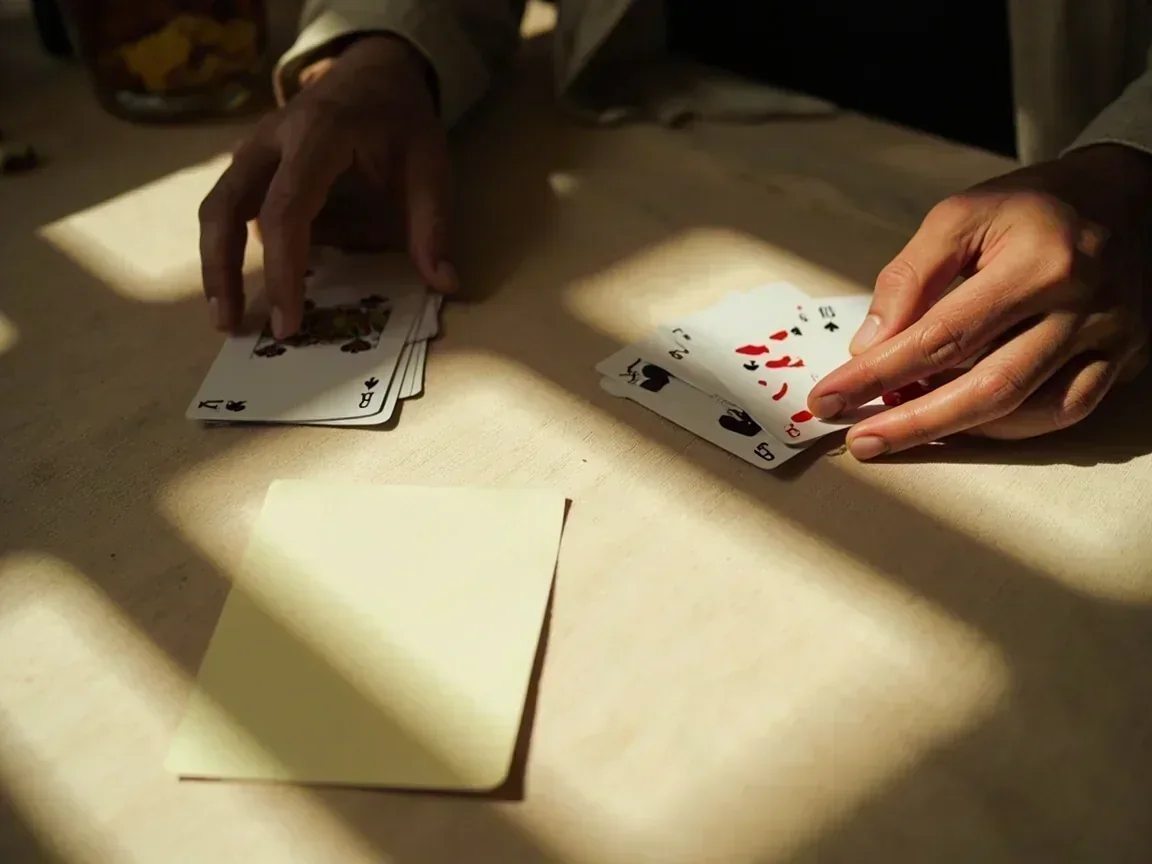 Drop or declare: one hand closed, one row still open.
Declaration is a show, not a hope
You declare when the required sequences are on the table, including the pure sequence, and the remaining cards form legal sets or a second sequence. You do not declare because the sitting has gone on too long.
The closed hand in the photograph is the drop option. The open row is the show option. If neither is ready, you draw and discard again.
An invalid show is worse than waiting. In common practice it is billed as a full leftover count. Do not test that on a guess.
Unpublished house values
TimerUnknown
Auto-dropUnknown
First dropUnpriced
SequencesTwo, one pure
Worked opening hand without a prize story
Suppose the dealt thirteen include 4-5 of hearts, 9-10 of spades, three unmatched face cards and no joker. The hearts can become a pure sequence if a 3 or 6 of hearts arrives. The spades are a second-sequence candidate. The face cards are deadwood until they form a set.
The first discard should not be a heart connector. The first drop remains available if both suits stall after a few turns. None of that is a Megawin payout example. It is the declaration order applied to a concrete shape.
This note does not restage the format chooser
Points, Deals and Pool change the bill. They do not change the meaning of a pure sequence. After you can walk deal-draw-discard-show, open the format ledger and pick the scoring unit. Doing both jobs in one sitting produces a beginner mash this desk refuses.
Common invalid shows
One sequence and the rest loose cards. Two sets and no run. A run that uses a joker as its only sequence. A run that skips a rank. A set that repeats a suit in a house that forbids it. If you cannot name which of those you are avoiding, you are not ready to tap declare.
Discard reading is not a later strategy essay
This note names discards only as a legal action in the sequence. Which card to throw, and when a 10-J-Q should be broken to cut deadwood, belongs on the strategy desk. Mixing those jobs here would clone the boundary list.
If a neighbour picks every heart you throw, that is information. It still does not tell you the next stock card. Keep that distinction now so the later note does not have to repeat the order of play.
A second worked shape: joker in the wrong place
Suppose you hold 6-7 of diamonds, a printed joker, three 10s and scattered low cards. Placing the joker as a 5 or 8 of diamonds makes a run, but that run is not pure. The three 10s are a set. You still need a natural sequence before any show.
The correct use of that joker is usually the second sequence or a set, after a natural run exists. If the diamonds never complete naturally, the honest actions are keep drawing or drop. Forcing a show with a joker-only run is the invalid-show pattern this sequence exists to stop.
After the sequence is clear
Declaration questions
Can a printed joker finish my only sequence?
In common 13-card practice, no. The pure sequence must be natural. A joker can help a second sequence or a set.
What is an invalid show?
A declaration that lacks the required sequences. The usual result is a full leftover count. Megawin's exact penalty is unpublished.
Does Megawin auto-drop on a timer?
A timer or auto-drop value is unpublished here. Do not assume a house clock.
When the sequence is memorised, stop rereading it
If you can recite deal, draw, discard, show and invalid show without looking, this note has finished. Further rereading will not create a Megawin timer that does not exist. Move to Formats or to the chance boundary.
Continue to the job that comes next
Sorting the hand without teaching the table
Sort by suit first if you are hunting a pure sequence. Sort by rank if you are hunting sets. Mixing both sorts every other turn wastes time and exposes indices. Keep the hand close. The teaching photograph already showed a laid sequence. Your live hand should not become a second teaching poster for a neighbour.
If a timer exists and is unpublished, assume you do not have infinite rearranging time. Decide the primary hunt, then draw.
Open discard versus closed stock, as a rule of action
Taking the open card is public. Drawing closed is private. The rule does not say which is wiser. It only says you do one, then you discard one, unless you are declaring.
If you take the open card and cannot use it, you have advertised a need and still must throw something else. That cost is part of the sequence, not a later strategy lecture.